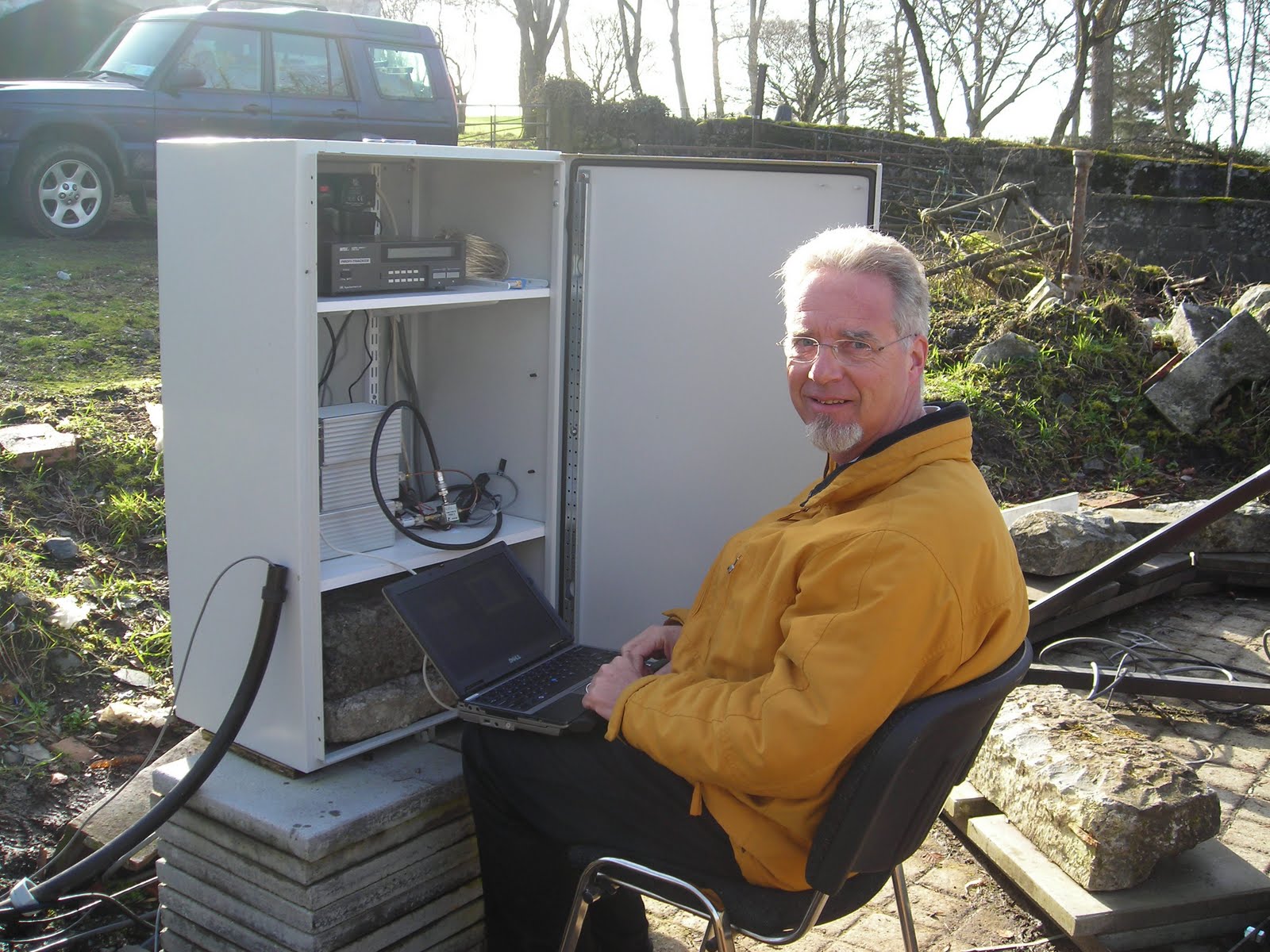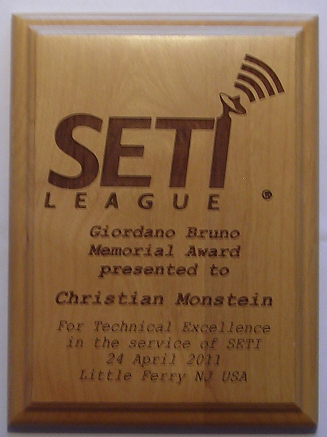
The SETI League recognized Christian Monstein, its volunteer Regional Coordinator for Switzerland, with its annual Giordano Bruno Memorial Award, for technical excellence in the service of SETI. A radio amateur (HB9SCT) and electronics engineer at the Institute for Astronomy of the Swiss Federal Institute of Technology Zurich (ETH Zurich), Mr. Monstein is responsible for the design, construction, and deployment of a global network of spectrometers for solar research. Currently, his CALLISTO (Compound Astronomical Low-cost Low-frequency Instrument for Spectroscopy in Transportable Observatory) spectrometers are deployed at 19 sites around the globe, all linked via the Internet. Featured in Nature magazine online in February, these instruments afford radio astronomers the most extensive network ever developed to monitor solar flares.
Freitag, 29. April 2011
Giordano Bruno Award received
The SETI League recognized Christian Monstein, its volunteer Regional Coordinator for Switzerland, with its annual Giordano Bruno Memorial Award, for technical excellence in the service of SETI. A radio amateur (HB9SCT) and electronics engineer at the Institute for Astronomy of the Swiss Federal Institute of Technology Zurich (ETH Zurich), Mr. Monstein is responsible for the design, construction, and deployment of a global network of spectrometers for solar research. Currently, his CALLISTO (Compound Astronomical Low-cost Low-frequency Instrument for Spectroscopy in Transportable Observatory) spectrometers are deployed at 19 sites around the globe, all linked via the Internet. Featured in Nature magazine online in February, these instruments afford radio astronomers the most extensive network ever developed to monitor solar flares.
Donnerstag, 7. April 2011
Observing coverage e-Callisto in April 2011
Sonntag, 27. Februar 2011
Installation #20 Birr castle Ireland

2nd installation of a low frequency Callisto at Birr castle, Ireland. Instrument will be operated by Trinity College Dublin.
Peter, Pietro, Joe, Eoin and Christian were working very hard to get everything running within two days...
We already got 1st light on February 27th 2011, it is a type III flare going down to about 30 MHz. Data access here: Rosseobservatory.
Below a video (9.34MB) about positioning the logarithmic-periodic antenna to the sun.
Samstag, 19. Februar 2011
Installation #19 Anchorage Alaska USA

Top: First light in Alaska on Feb. 15th 2011 at ~02:00UT.
It shows a type IV solar radio flare which was connected to a strong x-ray flare X2.2
System was built, tested and will be operated by W. Reeve Anchorage.
FIT-files are automatically transferred to a shared FTP-server.
Middle: Logarithmic-periodic antenna on the roof, tracking the sun.
Bottom: Control-PC and Callisto (right on the table).
Link to an article in Nature about e-Callisto network of Feb. 17th, 2011.
Link to an interview in Swiss news SFDRS of Feb. 18th 2011.
Samstag, 13. November 2010
Installation #18 at Space Weather Monitoring Centre Helwan, Egypt

Top: Callisto radio spectrometer at SWMC Helwan university Cairo, Egypt
Bottom: Spectral overview in the SWMC office taken with an omni-directional antenna (no preamplifier).
Plot produced with IDL.
Installation during 1st ISWI-meeting in Cairo
Freitag, 17. September 2010
2nd generation of Callisto
Freitag, 10. September 2010
Installation #17 at Metsähovi observatory, Finland

17# Callisto installation at Metsähovi Radio Observatory in Finland took place 1st of September until 3rd of September 2010. Access to on-line data and lightcurves via web-interface here:
http://www.metsahovi.fi/callisto/
The logarithmic periodic antenna (DBV-T) is attached to the rim of a microwave telescope dish that observes the solar radio flux at 11 GHz. Picture taken by Juha Kallunki MRO.
Abonnieren
Posts (Atom)