Samstag, 12. Oktober 2013

New Callisto Solar Radio Telescope at Bosscha Observatory, Lembang, Indonesia


Crew in front of control room, front from left to right: Iwa Sutisna, Agus Setiawan, Hendro Setyanto, Putra Mahasena, Taufiq Hidayat. Behind: Maman Budiman, Denny Mandey, Dhani Herdiwijaya. The antenna CLP 5130-1 is in the background. 

Maman Budiman (left) and Agus Setiawan (right) in the control room.


Longitude: 107 deg 37’ 0.5’’ E, Latitude: 6 deg 49’ 29.6’’ S, Altitude: 1310 m, Antenna:  CLP 5130-1

Freitag, 13. September 2013

New Callisto installed in South Africa

A new spectrometer has been set into operation at SANSA (South African National Space Agency) in Hermanus 7200, South Africa.

Top: LPDA pointing to the meridian transit of the sun in South Africa
Bottom: Callisto and PC in the observatory.

Now, we are waiting for the 1st light. Unfortunately the sun is very quiet at the moment....

Montag, 29. Juli 2013

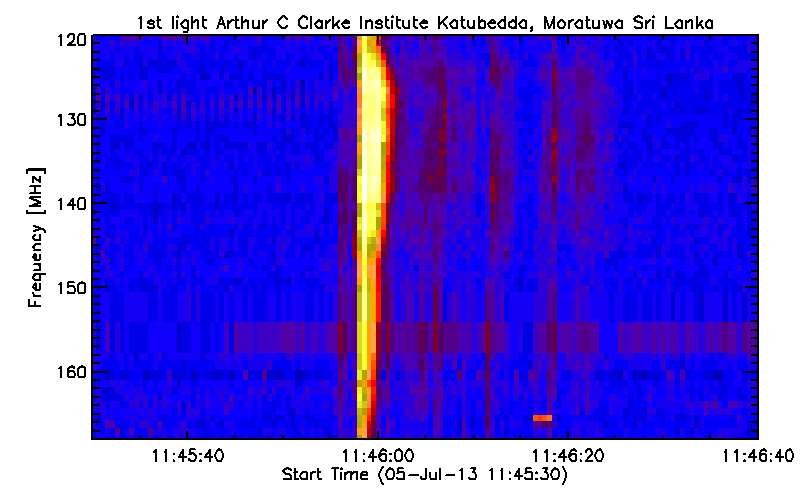
New Callisto spectrometer in Sri Lanka installed


The CALLISTO Solar Radio Observatory is established in the Arthur C Clarke Institute (ACCIMT), Colombo, Sri Lanka. The location of the CALLISTO system is 6o 47’ 37’’ N, 79o 53’ 53’’ E at an altitude of 40 m and the time zone is +5.30 from UT. The log-periodic antenna was completely designed by the ACCIMT and constructed locally. Design constant (t) 0.822 and the relative spacing (s) 0.149 give 7 dBi theoretical gain for the log – periodic antenna and it covers the frequency range of 45 – 600 MHz with 18 dipoles. The theoretical impedance of the antenna 58.3 Ω is well agreed with the impedance measured in the entire frequency range. The total height of the antenna is 5.38 m and the longest dipole is 3.33 m. The linear polarized antenna is pointing to zenith and the dipoles directed to north-south direction.
The pre-amplifier is made by ACCIMT using MAR-8ASM Monolithic surface mount amplifier which gives 31.5 dB gain at 100 MHz.    

The members of astronomy division. From left; Saraj Gunasekara, Janaka  Adassuriya, Kamal Perera, Indika Medagangoda.

1st ligth, a type III burst. X-axis is local time
Rather crowded spectrum, nevertheless solar observations are still possible.