Sonntag, 19. Mai 2013

New Callisto at Hvezdaren Roztoky in Slovakia

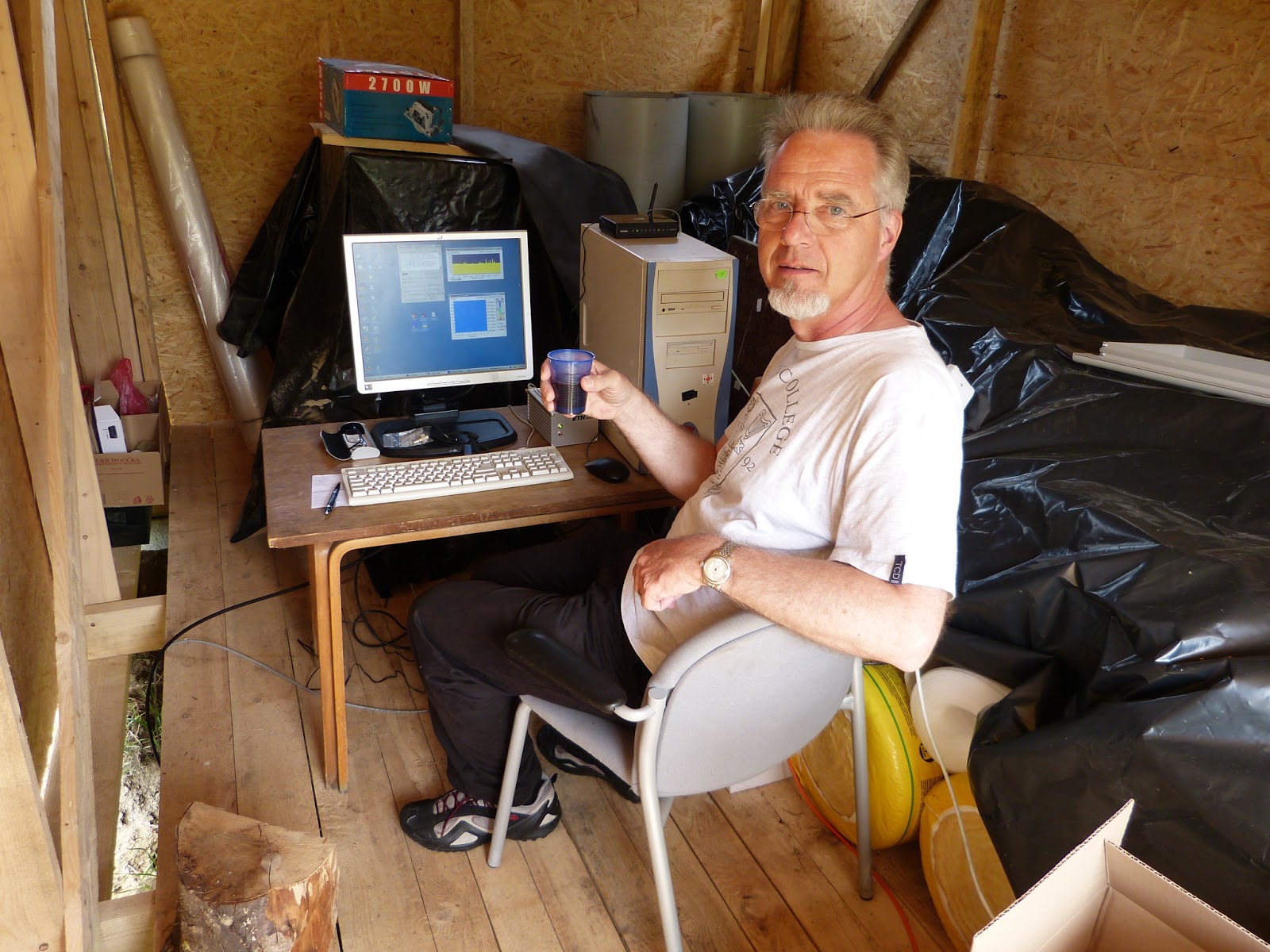
On April 30th 2013 a new Callisto spectrometer has been installed and configured at the observatory Roztoky in eastern Slovakia. The antenna is a commercial LPDA CLP-5130 followed by a low noise Mini Circuits pre-amplifier.

The author with a glass of red wine after succesful installation and configuration of the instrument in a temporary shed.

 2nd light, a type IV solar radio burst connected to a M-flare.

Interference situation compared with other radio sources.

Sonntag, 14. April 2013

M6.5 x-ray flare produced nice type II radio burst

5330       0655   0716      0729  G15  5   XRA  1-8A      M6.5    7.4E-02   1719
5330       0656   0710      0906  SVI  3   FLA  N09E12    3B      UMB       1719
5330 +     0656   0658      0811  LEA  G   RBR  1415      3000              1719
5330       0657   ////      0846  LEA  C   RSP  025-180   VI/1              1719
5330       0657   0658      0859  LEA  G   RBR  245       2700              1719
5330 +     0657   0707      0845  LEA  G   RBR  410       340               1719
5330       0658   0707      0830  LEA  G   RBR  610       830               1719
5330 +     0658   0702      0718  LEA  G   RBR  2695      470               1719
5330 +     0658   0710      0716  LEA  G   RBR  4995      310               1719
5330 +     0702   ////      1712  SVI  C   RSP  025-180   IV/3              1719
5330 +     0702   ////      0709  CUL  C   RSP  045-160   II/3              1719
5330 +     0702   0710      0723  LEA  G   RBR  8800      210               1719
5330 +     0703   ////      0720  CUL  C   RSP  025-090   III/3             1719
5330 +     0710   0710      0710  LEA  G   RBR  15400     100               1719 
 
Nice type II burst observed at BIR observatory of TCD in Ireland
with low cost spectrometer Callisto.
Antenne is a biconical from Schwarzbeck/Germany.

Mittwoch, 13. März 2013

1st light Callisto in Roswell New Mexico

Another Callisto spectrometer (NA014) has been set into operation in Roswell New Mexico, connected to a log-per antenna CLP-5130. 1st ligth burst was observed on March 11th 2013. Thanks and congratulations to Stan Nelson. Welcome on board of the e-Callisto network! This observatory very much increases the American/Pacific coverage. Now we are very close to 24h/365d observation scheme.

With this new node we have full coverage 24h/365d. This after 11 years of activity in connection with IHY2007 and ISWI.

Donnerstag, 21. Februar 2013

1st light burst Callisto at University of Alcalá, Spain

1st light observed with Callisto at University of Alcalá, Spain on February 17th, 2013. Congratulations and welcome on board of the e-Callisto network!

Mittwoch, 16. Januar 2013

Type II burst observed by the e-Callisto network

On January 13th a nice type II burst was observed by more than 15 stations of the e-Callisto network worldwide. Here some nice examples of the event. These plots can be used to improve instrumental quality or they can be used to derive the speed of the CME.


Solar Total Power Radio Interferometer

Total power solar radio interferometer composed of two WiFi antennas at an East-West distance of 8 m, a down-converter and a Callisto spectrometer. While the sun moves through the beam pattern the receiver detects this interference pattern. By analyzing this pattern, the radio-diameter of the sun can be obtained. This even during bad weather conditions like snowfall or fog. Observation was made by students of ETH Zurich during Astrowoche 2013 at Diavolezza, 3000 m asl. The diameter was found to be in the order of 0.65 degree. The value will be statistically improved in the coming days.
WiFi-antennas in the snow, south of Hotel Diavolezza pointing to meridian transit of the sun.
Signals of both antennas are first amplfied by ~20dB, then fed into a Wilkinson-power combiner. The combined signal is fed into an S-band down-converter (KUHNE-Elektronik Germany). The IF output of the converter is fed via a long 50 ohm coax into the observatory and to a Callisto spectrometer.

Dienstag, 2. Oktober 2012

Solar Radio observation at the observatory site of Glasgow University, UK


Installation of an LPDA (Create Japan) in the garden of the observatory. Although the spectrum is quite crowded, there are some gaps which allow solar radio burst observations. Now we are waiting for the 1st light. Green bars mark frequency ranges which are protected for Radio Astronomy in the UK.
1st light Callisto Scotland, UK.